





Game Design Philosophy - A Chat with Elliot of OCG
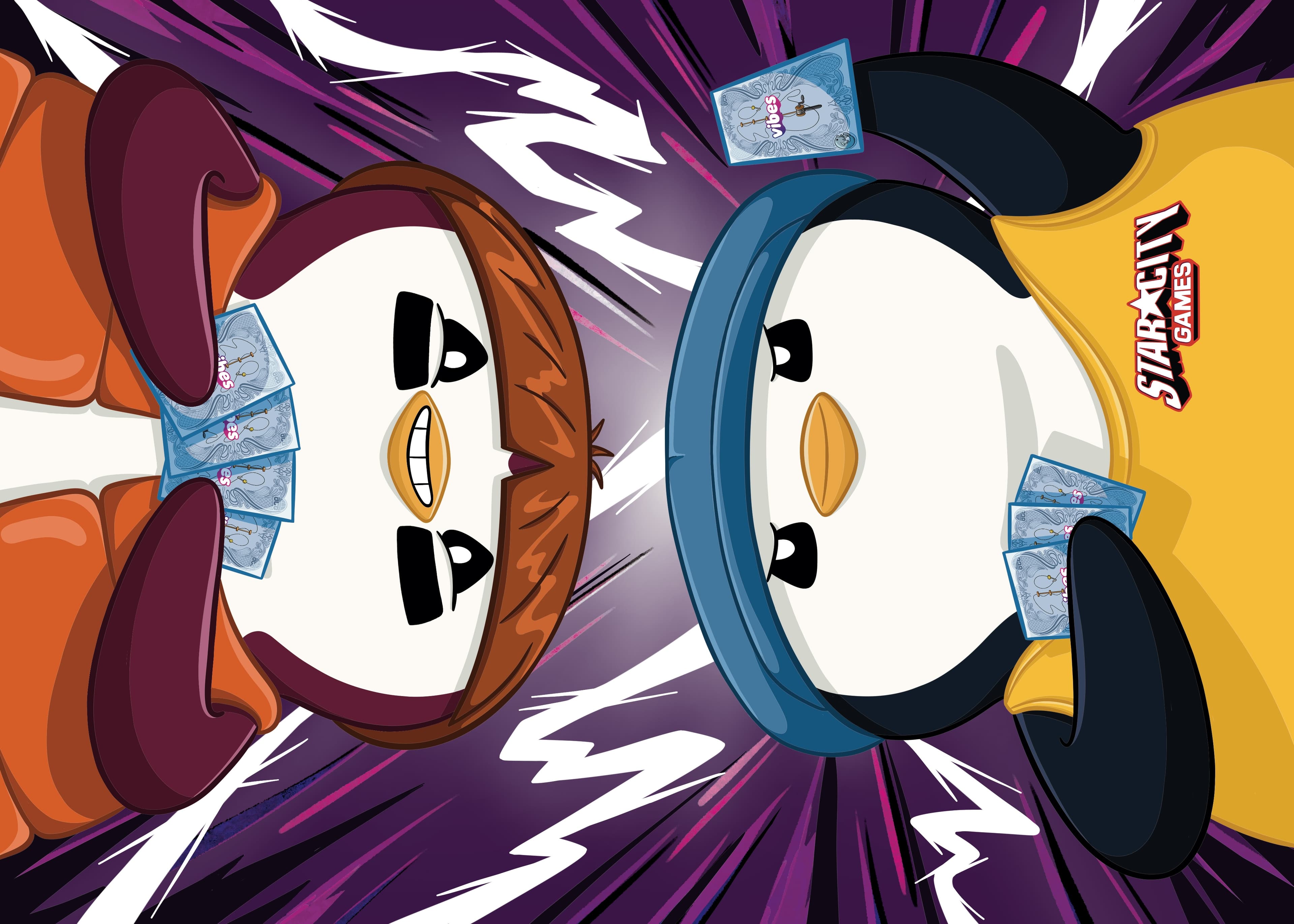
Tell us a bit about yourself and your role on the Vibes team.
Hi, I'm Elliot, Head of Game Design here at Orange Cap Games. I touch a variety of things, but most of my time is spent on Vibes, our flagship trading card game, which I co-design with Spencer, our CEO and fearless leader.
Vibes began in 2023, when Spencer and I decided we wanted to make a trading card game together by combining our different backgrounds. Spencer comes from a strong competitive Magic: The Gathering background, while mine is more rooted in casual games—trading card games, but also short-form multiplayer experiences.
What does your design process look like? Where does a new card or mechanic start, and how does it evolve from there?
For mechanics specifically, we usually start by looking at the existing card pool and the design space we've already explored. From there, Spencer and I come up with ideas we think are interesting—mechanics or concepts we haven't really touched before.
We build small groups of cards around those ideas, playtest them, and use that feedback to narrow down what started as a bunch of interesting mechanics into the ones that are actually fun. One temptation as game designers is trying to make the process of designing feel like a game itself, where you're always chasing clever solutions instead of good ones. So we work hard to cut things that are cool just for the sake of being cool, and focus on mechanics that play well, feel intuitive, and create great experiences for players.
Once we find archetypes that resonate with new, casual, and competitive players, we expand them across the color pie. We build the ideal versions of those decks first, then add interesting cards that create alternate ways to play them.
From there, a lot of other considerations come into play. We think about symmetry across colors, cycles, and callbacks to previous sets. We also have to predict where the metagame will be—not just where it is now, but where it'll be by the time the set releases, since we're designing future sets before the previous one has even been spoiled. That means creating answers to emerging strategies, strengthening underperforming archetypes, and making sure the format stays interesting.
We also spend a lot of time thinking about onboarding new players. The order players encounter mechanics matters. A one-cost card with a wall of text might be great competitively, but it's a confusing first experience for someone learning the game. So every color needs cards that let us build intro decks which teach mechanics naturally as players progress.
Finally, we check the entire card pool for unintended interactions and combos, make sure abilities line up with the artwork and flavor, and balance all of those competing goals. There are a lot of moving pieces, but that's ultimately how we arrive at a final set of 150 to 200 cards.
What's something that was harder to get right than players might expect? (balance struggles, ideas that got cut, things that went through lots of iteration)
Players already expect balance to be difficult, and they're right. Vibes is currently a single eternal format where every card is legal, which means there are an enormous number of card interactions to consider. It also means that answering dominant strategies is tricky—you either print cards that specifically counter them, ban cards (which we try to avoid), or introduce some amount of power creep, which is healthy in moderation but can become a problem if it gets out of hand.
What players might not expect, though, is how often we create really fun cards in playtesting that never get printed simply because we can't explain them clearly enough on the card.
A good example is Koi Penguin from Set 1. Once you understand what it's doing, the ability makes perfect sense, but wording concepts like "highest vibing Character in your huddle” in a way that's immediately understandable is surprisingly difficult. Since we don't rely heavily on keywords, we only have about 200 characters to make an ability both interesting and easy to understand.
The same challenge comes up whenever we introduce a new mechanic. Cards like Saucy Actions have a lot of reminder text, even though the mechanic itself is pretty intuitive after you've played with it a few times. That's a deliberate choice—we want players to be able to understand a card just by reading it, because it makes the game much more approachable. But as the card pool grows, balancing complexity, clarity, and interesting design becomes one of the hardest parts of making new sets.
How do you think about balancing fun and fairness? Especially for a game that's both family-friendly and competitive.
This is a great question, and it's really rooted in the fact that casual and competitive players often find different things to be fun.
There are plenty of things both groups enjoy, and we try to make those central to the game. But there are also places where their preferences compete.
Casual players tend to enjoy consistency. They like games with a predictable structure, hidden information, and certain rules they can always rely on. For example, they like knowing they're the only one who can act during their own turn, or that if their opponent has fewer than 14 cards at the start of Action Time, they don't have to worry about suddenly losing before the end of the cycle. They don't want to constantly think about every possible card their opponent could have—they want the game's baseline assumptions to stay true. That gives them a feeling of control over something that's otherwise very complex.
They also tend to enjoy cards whose power level is intuitive. If a card costs a lot of fish, it should probably do something really powerful. Those kinds of expectations make the game easier to learn and more satisfying to play for those players.
Competitive players are almost the opposite. They enjoy finding cards and deck combinations that break those assumptions. They like discovering interactions that redefine what's possible and reward deep knowledge of the card pool.
Because of that, there are times when both audiences simply can't want the same thing. Our job is to make sure each set has something for both groups. Some cards are designed knowing they'll mostly shine in competitive play, while others are aimed squarely at casual players, and both can happily exist in the same set.
Thanks so much to Elliot for taking the time to answer some questions! Stay tuned on the blog for more interview-style content.